
In the 2012-13, car sales in India fell 6.69 per cent, which was the first decline in a decade.

The recall is only for the diesel variants of the three models. Out of the total, 55,938 units are of old Dzire, 12,486 units of old Swift and 1,131 units of Ritz, which were manufactured between March 8, 2010 and August 11, 2013, the company said.

India's biggest car maker Maruti Suzuki said on Tuesday that its vehicle production in September will tumble by 60 per cent due to chip shortage. The company, which had earlier cut down production at its Gujarat plant, said the chip shortage will hit production in Gurugram and Manesar plants, effectively forcing the automaker to cut production by 60 per cent. Owing to a supply constraint of electronic components due to semiconductor shortage, the company is expecting an adverse impact on vehicle production in September in both Haryana and its contract manufacturing company, Suzuki Motor Gujarat Pvt Ltd. (SMG) in Gujarat.

Passenger vehicle wholesales in India declined nearly 4 per cent to 279,501 units last month, auto industry body SIAM said on Wednesday. Passenger vehicle (PV) dispatches from factories to dealerships in March 2021 stood at 290,939 units. As per the latest data by the Society of Indian Automobile Manufacturers (SIAM), two-wheeler sales also fell 21 per cent to 11,84,210 units as compared with 14,96,806 vehicles in March 2021.

Passenger vehicle wholesale in India increased by 14.19 per cent to 3,10,294 units in October against 2,71,737 units in the same month last year as companies despatched more units to dealers to cater to enhanced demand in the festive season, auto industry body SIAM said on Wednesday. According to the latest data by the Society of Indian Automobile Manufacturers (SIAM), two-wheeler sales also rose 16.88 per cent to 20,53,814 units, compared with 17,57,180 units in the same month last year. Motorcycle sales were at 13,82,749 units as against 11,16,886 units in October 2019, up 23.8 per cent.

Electric two-wheelers have zipped past the half-a-million registration mark and achieved a market penetration of 4 per cent at the fag end of Calendar 2022, according to data released by VAHAN. According to VAHAN data for the year (until December 27), 560,000 two-wheelers were registered in the country, up a staggering fourfold over 2021, when only 136,000 were registered, and when electric vehicle penetration was a mere 1.05 per cent. The total number of two-wheelers (internal combustion engine, or ICE, and electric) registered so far in 2022 stands at 14.5 million, up only 12.7 per cent over the previous calendar year.
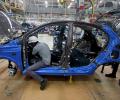
Automobile industry in India is going through a long-term structural slowdown as the compound annual growth rate (CAGR) across all major vehicle segments has witnessed a decline over the last three decades, as per industry body SIAM. The auto industry has been facing headwinds even before the COVID-19 pandemic derailed the entire sector last year, a research conducted by the Society of Indian Automobile Manufacturers (SIAM) has revealed. The study clearly shows that the pandemic is not the only reason for the auto sector slowdown, which is facing deeper structural issues that need attention, the industry body noted.

The industry is engaged in a dialogue with the Government of India on policy measures which could minimise the impact of COVID-19 on the Indian economy and especially the domestic automobile industry.

Passenger vehicle sales in India could hit a record of over 38 lakh units in FY23 but the strong growth momentum is not expected to carry over to 2023-24 with pent-up demand already been released, according to Tata Motors Passenger Vehicles managing director Shailesh Chandra.

During the six-day-long event, automakers have planned 10 global launches, 26 India specific launches, six concept vehicles, seven facelifts and 21 vehicle unveilings.
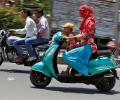
Two-wheeler exports from India fell by 17.8 per cent to 3.65 million units in 2022-23 (FY23), according to data released by the Society of Indian Automobile Manufacturers (Siam) on Thursday. This decline is due to a rise in global inflation and the weakening of economies and currencies in key export markets of Africa, Latin America (LatAm), and South Asia. In contrast to FY23, two-wheeler exports from India jumped 35.4 per cent to 4.44 million units in 2021-22 (FY22).

Prime Minister Narendra Modi made a pitch for electing a strong and stable government in an uncertain world beset by geopolitical tensions as the Bharatiya Janata Party on Sunday released its manifesto, prioritising development and welfare while shunning populist measures and contentious issues like the National Register of Citizens (NRC).

Passenger vehicle wholesales in India increased by 11.14 per cent to 2,76,554 units last month as compared with same month last year amid supply chain challenges, unavailability of semiconductors and higher container charges, auto industry body SIAM said on Thursday.

Hero MotoCorp, Honda Motorcycles, Scooters India, TVS, Honda India, Toyota Kirloskar Motor, Ford, Nissan, Ashok Leyland are all giving the Auto Expo a miss this time.

The exercise is in keeping with SIAM's voluntary code on vehicle recall

India on Sunday announced temporary suspension of e-visa facility for Chinese travellers and foreigners residing in the neighbouring country and issued a fresh advisory saying anyone with travel history to China since January 15 can be quarantined.

Clock 11% growth in the first 11 months of 2022.

Two-wheeler sales were down 15.24 per cent in July to 12,81,354 units as compared with 15,11,717 units in the same month last year.

Tata Motors, India's third largest passenger vehicle maker, took pole position in the competitive sport utility vehicle (SUV) market in October, reveals the data from industry sources. Riding high on the Punch - the sub-compact SUV offering launched on October 18 - the Tata group flagship sold a record 23,381 units in October, higher than 20,022 units sold by archrival Mahindra & Mahindra, 18,538 units sold by Hyundai Motor India, and 15,931 units sold by Kia Motors India. Utility vehicles - that include SUVs and multipurpose vehicles - accounted for almost one in every two passenger vehicles sold in India in the first seven months of the current financial year, according to the Society of Indian Automobile Manufacturers.

Passenger vehicle wholesales in India increased by 12.73 per cent to 285,367 units in November as against 253,139 units in the same month last year riding on the back of festive demand, auto industry body SIAM said on Friday. According to the latest data by the Society of Indian Automobile Manufacturers (SIAM), two-wheeler sales rose 13.43 per cent to 16,00,379 units, compared with 14,10,939 units in the same month last year.

Owing to the poor market conditions and tepid sentiments, the size of the show has shrunk compared to the last edition, which took place in 2018. A majority of the two-wheeler makers, and several car and commercial vehicle makers, have opted out of this year's show, which opens for the media on Wednesday.
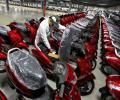
Retail sales of cars are back to January 2018 levels in August 2021. Two-wheeler retail sales are 22 per cent lower, nearly four years down the line.

This is the first decline since June this year when car sales declined by 11%.

Chinese players form a major part, around 20 per cent of the auto expo this year, despite a slowdown in the Indian automobile sector in the last one year. Over two dozen top officials from various companies were planning to participate in the event, besides a group of journalists.

SIAM said excise duty must be lowered
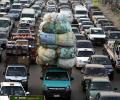
SIAM also said the ban, which is in effect since December 16, has resulted in production loss of around 11,000 units
.jpg)
According to industry body Society of Indian Automobile Manufacturers and Automotive Component Manufacturers Association of India, with demand continuing to be low and factories not operating at full scale, this may lead to temporary excess overheads.
Most of the leading vehicle manufacturers were before the court, though their stand was not identical and sometimes contradictory.

Vehicle prices have gone up as manufacturers gear up for the transition to stricter emission norm BS-VI from BS-IV beginning April 1.
The final Budget for the fiscal is likely to be tabled in July after formation of the new government.
Dealers attribute the sluggishness in sales to distress in rural India as well as tepid sentiment in urban markets.

Two years after it hitched a ride with Hero MotoCorp (Hero), Harley-Davidson (Harley) and the Pawan Munjal-led firm are gearing up to ride into the middleweight (midweight) motorcycle segment (350-850cc) in the world's largest two-wheeler market.

Higher exports will also drive up volumes, as the company seeks to avail of the benefits under the government's recently announced production linked incentive scheme.
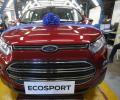
Sanand plant exported 78,930 cars. The one at Chennai exported 79,539 units of EcoSport model

Prices of automobiles, including cars, sports utility vehicles and two-wheelers, are set to come down with Finance Minister P Chidambaram announcing a reduction in excise duty in the Interim Budget.
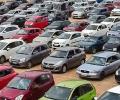
The economy segment of India's car market is unlikely to revive soon term as inflation and prices prompt buyers to defer purchases. The share of entry-level cars in the passenger vehicle market dropped to the lowest in seven years at the end of the Financial Year 2021-22 (FY22). A recovery in the segment will be largely driven by the overall economic growth, improvement in income levels, and easing of semiconductor shortage, say carmakers and analysts.

While two-wheeler sales declined 22 per cent, two other segments, bigger in value while being lower in volume, were much less impacted.

Prime ministers turning up with such frequency to launch trains is an indication of the political mileage resident in public transport. Will our railways step out of the government's shadow? After all, they are the ones manufacturing trains and running them, notes Shyam G Menon.

'What's sad today is that there are so many people who cannot find work, not because the country is devoid of that opportunity, but because we are not doing enough in the country.'
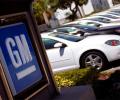
The move marks the entry of GWM, one of the largest manufacturers of sport utility vehicles (SUVs) and pick-ups, into the Indian market and a complete exit for GM from the country, two years after it stopped selling cars here.
 © 2026 Rediff.com - Advertise with us - Disclaimer - Privacy Policy - Sitemap - Feedback - About us - Terms of use - Grievances